|
|
– Enlarged view – |
| • references | |
| Brand F (1991) Ektomykorrhizen an Fagus sylvatica. Charakterisierung und Identifizierung, ökologische Kennzeichnung und unsterile Kultivierung. Libri Botanici 2: 1-229. Brand (1992) Tricholoma sciodes. In Agerer R (ed) Colour Atlas of Ectomycorrhizae, plate 74, Einhorn-Verlag, Schwäbisch Gmünd. |
|
| • length | |
| 0 mm | Lower value of unspecified range (could be µ-s.d., but not known) |
| 4 mm | Upper value of unspecified range (could be µ+s.d., but not known) |
| • ramification presence-type | |
| monopodial-pyramidal | |
| • tips {per 10 mm} number | |
| 8 | Lower value of unspecified range (could be µ-s.d., but not known) |
| 16 | Upper value of unspecified range (could be µ+s.d., but not known) |
| • ramification orders | |
| 0 | Lower value of unspecified range (could be µ-s.d., but not known) |
| 1 | Upper value of unspecified range (could be µ+s.d., but not known) |
| • main axis diameter | |
| 0.3 mm | Lower value of unspecified range (could be µ-s.d., but not known) |
| 0.35 mm | Upper value of unspecified range (could be µ+s.d., but not known) |
| • rhizomorphs as stout, short, conical structures presence-abundance | |
| absent | |
| • rhizomorphs as short mycorrhiza-like outgrowths with blunt tips presence | |
| absent | |
| • rhizomorphs presence | |
| present | |
| • rhizomorphs frequency | |
| abundant | |
| • exploration type | |
| medium distance fringe | |
| • shape | |
| straight | |
| or | bent |
| • shape {of distal end} | |
| not inflated, cylindric | |
| • length | |
| 0 mm | Lower value of unspecified range (could be µ-s.d., but not known) |
| 1 mm | Upper value of unspecified range (could be µ+s.d., but not known) |
| • diameter | |
| 0.25 mm | Lower value of unspecified range (could be µ-s.d., but not known) |
| 0.35 mm | Upper value of unspecified range (could be µ+s.d., but not known) |
| • colour | |
| brown | |
| or | ochre, yellowish brown |
| or | red |
| or | white |
| • very tip colour | |
| brown | |
| or | ochre, yellowish brown |
| or | reddish |
| or | whitish |
| • older parts colour | |
| brown | |
| • mantle {distinct} surface visibility | |
| present | |
| • mantle laticifers visibility | |
| absent | |
| • mantle dots presence-colour | |
| absent | |
| • mantle carbonizing presence | |
| absent | |
| • mantle surface {in general} habit | |
| silvery | |
| or | smooth |
| or | covered with soil particles |
| or | not smooth |
| • mantle surface {in detail} kind | |
| loosely stringy | |
| • emanating hyphae presence | |
| present | |
| • emanating hyphae abundance | |
| infrequent | |
| or | abundant |
| • emanating hyphae distribution | |
| not specifically distributed | |
| • ramification kind-frequency | |
| repeatedly into smaller filaments | |
| • connection to mantle kind | |
| oblique | |
| • origin location | |
| not specific | |
| or | proximal |
| • margin habit | |
| hairy | |
| or | fan-like |
| • dimorphism presence | |
| absent | |
| • presence | |
| absent | |
| • emanating elements presence-type | |
| rhizomorphs | |
| • blue granules presence | |
| absent | |
| • presence | |
| absent | |
| • organisation | |
| plectenchymatous | |
| • mantle type | |
| hyphae rather irregularly arranged and no special pattern discernible (type B) | |
| • hyphal system kind | |
| undifferentiated | |
| • septa thickness {relative to cell walls} | |
| as thick as walls | |
| • septa clamps presence | |
| absent | |
| • cell shape | |
| cylindric, not constricted at septa | |
| • cell pigment location-colour | |
| absent | |
| • cell diameter | |
| 2.5 µm | Lower value of unspecified range (could be µ-s.d., but not known) |
| 3.5 µm | Upper value of unspecified range (could be µ+s.d., but not known) |
| • cell wall thickness | |
| 0.3 µm | Mean (= average) |
| • cell wall surface habit | |
| smooth | |
| and | rough |
| • drops of exuded pigment presence | |
| absent | |
| • organisation | |
| plectenchymatous | |
| • hyphae arrangement | |
| plectenchymatous, without pattern | |
| • cell pigment location-colour | |
| colourless | |
| • cell diameter | |
| 2.5 µm | Lower value of unspecified range (could be µ-s.d., but not known) |
| 4 µm | Upper value of unspecified range (could be µ+s.d., but not known) |
| • cell contents presence-kind | |
| absent | |
| • cell wall thickness | |
| 0.5 µm | Mean (= average) |
| • cell wall surface habit | |
| smooth | |
| • organisation | |
| plectenchymatous | |
| • hyphae arrangement | |
| without pattern | |
| • septa clamps presence | |
| absent | |
| • cell pigment location-colour | |
| absent | |
| • cell diameter | |
| 2 µm | Lower value of unspecified range (could be µ-s.d., but not known) |
| 3 µm | Upper value of unspecified range (could be µ+s.d., but not known) |
| • cell contents presence-kind | |
| absent | |
| • anatomy mantle outer mantle layer {of ectomycorrhizal tip} organisation | |
| like other parts of mantle | |
| • mantle thickness {apart from tip} | |
| 30 µm | Minimum value |
| 35 µm | Lower value of unspecified range (could be µ-s.d., but not known) |
| 45 µm | Upper value of unspecified range (could be µ+s.d., but not known) |
| 50 µm | Maximum value |
| • mantle different layers presence | |
| not discernable | |
| • outer mantle layer organisation | |
| plectenchymatous | |
| • middle mantle layer organisation | |
| plectenchymatous | |
| • inner mantle layer organisation | |
| plectenchymatous | |
| • unlayered mantle hyphae radially diameter | |
| 2.5 µm | Lower value of unspecified range (could be µ-s.d., but not known) |
| 4 µm | Upper value of unspecified range (could be µ+s.d., but not known) |
| • presence | |
| absent | |
| • anatomy mantle longitudinal section cortical (epidermal) cells shape | |
| radially-oval to -elliptic, oriented obliquely | |
| • anatomy mantle longitudinal section cortical (epidermal) cells tangentially length | |
| 6 µm | Lower value of unspecified range (could be µ-s.d., but not known) |
| 18 µm | Upper value of unspecified range (could be µ+s.d., but not known) |
| • anatomy mantle longitudinal section cortical (epidermal) cells radially diameter | |
| 15 µm | Lower value of unspecified range (could be µ-s.d., but not known) |
| 43 µm | Upper value of unspecified range (could be µ+s.d., but not known) |
| • anatomy mantle longitudinal section cortical (epidermal) cells mean shape-ratio CCq (ECq) | |
| 0.25 | Minimum value |
| 0.4 | Mean (= average) |
| 0.6 | Maximum value |
| • mantle different layers presence | |
| not discernible | |
| • outer mantle layer organisation | |
| plectenchymatous | |
| • middle mantle layer organisation | |
| plectenchymatous | |
| • inner mantle layer organisation | |
| plectenchymatous | |
| • unlayered mantle hyphae radially diameter | |
| 2.5 µm | Lower value of unspecified range (could be µ-s.d., but not known) |
| 4 µm | Upper value of unspecified range (could be µ+s.d., but not known) |
| • anatomy mantle cross-section cortical (epidermal) cells shape | |
| round | |
| or | radially-oval to -elliptic |
| or | tangentially-oval to tangentially-elliptic |
| • anatomy mantle cross-section cortical (epidermal) cells tangentially length | |
| 9 µm | Lower value of unspecified range (could be µ-s.d., but not known) |
| 30 µm | Upper value of unspecified range (could be µ+s.d., but not known) |
| • anatomy mantle cross-section cortical (epidermal) cells radially diameter | |
| 11 µm | Lower value of unspecified range (could be µ-s.d., but not known) |
| 30 µm | Upper value of unspecified range (could be µ+s.d., but not known) |
| • anatomy mantle cross-section cortical (epidermal) cells mean shape-ratio CCq | |
| 0.5 | Minimum value |
| 0.8 | Mean (= average) |
| 1.1 | Maximum value |
| • anatomy mantle cross-section hyphal cells around cortical (epidermal) cells shape | |
| roundish | |
| • anatomy mantle cross-section hyphal cells around cortical (epidermal) cells thickness | |
| 1.5 µm | Lower value of unspecified range (could be µ-s.d., but not known) |
| 4.5 µm | Upper value of unspecified range (could be µ+s.d., but not known) |
| • anatomy mantle cross-section hyphal rows around cortical (epidermal) cells number | |
| one | |
| • lobes width | |
| 1 µm | Lower value of unspecified range (could be µ-s.d., but not known) |
| 4 µm | Upper value of unspecified range (could be µ+s.d., but not known) |
| • structure {in plan view} | |
| of palmetti type | |
| • intrahyphal hyphae presence | |
| absent | |
| • septal pores configuration | |
| dolipore-like structures | |
| • backwards-oriented clamps presence | |
| absent | |
| • anastomoses type | |
| open, with a short bridge or bridge almost lacking | |
| • anastomoses anastomosal bridge thickness {relative to hyphae} | |
| thinner | |
| or | as thick as |
| • shape | |
| not striking | |
| • cell pigment location-colour | |
| absent | |
| • drops of exuded pigment presence | |
| absent | |
| • presence | |
| present | |
| • kind | |
| acute | |
| • distance {from septum} | |
| adjacent to septum | |
| • side-branches at septum number | |
| one side-branch at septum | |
| • clamps presence | |
| absent | |
| • clamps hole presence | |
| absent | |
| • clamps blister-like structure {at basis} presence | |
| absent | |
| • anatomy emanating elements emanating hyphae cell shape | |
| slightly constricted | |
| • anatomy emanating elements emanating hyphae cell diameter | |
| 3 µm | Lower value of unspecified range (could be µ-s.d., but not known) |
| 4 µm | Upper value of unspecified range (could be µ+s.d., but not known) |
| • anatomy emanating elements emanating hyphae cell length | |
| 15 µm | Lower value of unspecified range (could be µ-s.d., but not known) |
| 100 µm | Upper value of unspecified range (could be µ+s.d., but not known) |
| • anatomy emanating elements emanating hyphae cell wall surface habit | |
| rough of warts | |
| or | without lens-shaped appositions |
| or | without spindle-shaped appositions |
| • anatomy emanating elements emanating hyphae cell wall thickness | |
| 0.3 µm | Mean (= average) |
| • anatomy emanating elements emanating hyphae cell wall {apart from tip} evenness | |
| even in thickness | |
| • type | |
| undifferentiated; hyphae rather loosely woven and of uniform diameter (type A) |
|
| • gelatinous matrix presence | |
| absent | |
| • gelatinized hyphae presence | |
| absent | |
| • cup-like structures on surface presence | |
| absent | |
| • conical young side-branches presence | |
| absent | |
| • a "ball" of intertwined, ramified, thin hyphae presence | |
| absent | |
| • ampullate, trumpet-like inflated presence | |
| absent | |
| • anatomy emanating elements rhizomorphs hyphae ampullate, trumpet-like inflated presence | |
| absent | |
| • anatomy emanating elements rhizomorphs hyphae ampullate, trumpet-like inflated presence | |
| absent | |
| • anatomy emanating elements rhizomorphs hyphae ampullate, trumpet-like inflated presence | |
| absent | |
| • anatomy emanating elements rhizomorphs hyphae ampullate, trumpet-like inflated presence | |
| absent | |
| • presence | |
| absent | |
| • {of ectomycorrhiza former} presence | |
| present | |
| • {of ectomycorrhiza former} abundance | |
| occasionally present | |
| • shape | |
| as small racemes | |
| • diameter | |
| 1 µm | Lower value of unspecified range (could be µ-s.d., but not known) |
| 2 µm | Upper value of unspecified range (could be µ+s.d., but not known) |
| • number {per cell} | |
| 2 | Mean (= average) |
| 4 | Maximum value |
| • shape | |
| round | |
| or | elongated |
| • diameter | |
| 1.5 µm | Lower value of unspecified range (could be µ-s.d., but not known) |
| 2.5 µm | Upper value of unspecified range (could be µ+s.d., but not known) |
| • length | |
| 1.5 µm | Lower value of unspecified range (could be µ-s.d., but not known) |
| 4 µm | Upper value of unspecified range (could be µ+s.d., but not known) |
| • distance {between each other} | |
| 0 µm | Lower value of unspecified range (could be µ-s.d., but not known) |
| 35 µm | Upper value of unspecified range (could be µ+s.d., but not known) |
| • whole mycorrhizae UV 254 nm colour-presence | |
| absent | |
| • whole mycorrhizae UV 366 nm colour-presence | |
| absent | |
| • mantle in section UV-filter 340-380 nm presence | |
| present | |
| • substrate | |
| in organic layer | |
| • soil pH | |
| acid reaction | |
| • geographic occurrence continent | |
| Europe | |
| • knowledge about association with foreign fruitbodies presence | |
| unknown | |
| • plant family | |
| Fagaceae | |
| • plant genus | |
| Fagus | |
| • plant habitat kind | |
| forests, woods | |
| • family | |
| Tricholomataceae | |
| • subgenus-section | |
| Tricholoma subg. Tricholoma | |
| • fruitbodies growth habit | |
| epigeous | |
| or | pileate-lamellate |
| • public notes | |
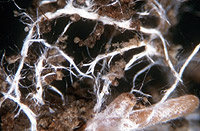
| Mycorrhizal systems irregularly monopodial-pyramidal; mycorrhizal ends infrequently slightly bent, light ochre to rosy-brown and often at patches of rhizomorph bases slightly white; in longitudinal section Hartig net 1-2 cortical cell layers deep, in cross-section 2-3; autofluorescence of mantle in section with UV-filter bluish-white, with blue-filter slightly greenish yellow. | |