|
|
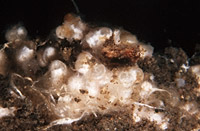
– Enlarged view – |
| • references | |
| Uhl M (1988) Identifizierung und Charakterisierung von Ektomykorrhizen an Pinus silvestris und von Ektomykorrhizen aus der Gattung Tricholoma. Diss Uni München. | |
| • length | |
| 3 mm | Lower value of unspecified range (could be µ-s.d., but not known) |
| 5 mm | Upper value of unspecified range (could be µ+s.d., but not known) |
| • ramification presence-type | |
| dichotomous | |
| or | coralloid |
| • rhizomorphs as stout, short, conical structures presence-abundance | |
| absent | |
| • rhizomorphs as short mycorrhiza-like outgrowths with blunt tips presence | |
| absent | |
| • rhizomorphs presence | |
| present | |
| • rhizomorphs frequency | |
| infrequent | |
| • exploration type | |
| long distance | |
| • shape | |
| straight | |
| • shape {of distal end} | |
| not inflated, cylindric | |
| • length | |
| 0 mm | Lower value of unspecified range (could be µ-s.d., but not known) |
| 0.6 mm | Upper value of unspecified range (could be µ+s.d., but not known) |
| • diameter | |
| 0.35 mm | Lower value of unspecified range (could be µ-s.d., but not known) |
| 0.4 mm | Upper value of unspecified range (could be µ+s.d., but not known) |
| • colour | |
| brown | |
| or | red |
| or | lilac, light reddish blue |
| • very tip colour | |
| brown | |
| or | brownish |
| • older parts colour | |
| dark brown | |
| or | brown |
| or | red |
| • mantle cortical cells visibility | |
| not visible | |
| • mantle {distinct} surface visibility | |
| present | |
| • mantle transparency | |
| not transparent | |
| • mantle laticifers visibility | |
| absent | |
| • mantle dots presence-colour | |
| absent | |
| • mantle carbonizing presence | |
| absent | |
| • mantle surface {in general} habit | |
| not smooth | |
| • mantle surface {in detail} kind | |
| loosely woolly | |
| • emanating hyphae presence | |
| present | |
| • emanating hyphae abundance | |
| abundant | |
| • diameter | |
| 0 mm | Lower value of unspecified range (could be µ-s.d., but not known) |
| 0.08 mm | Upper value of unspecified range (could be µ+s.d., but not known) |
| • cross-section shape | |
| round or roundish | |
| • connection to mantle kind | |
| distinct | |
| • dimorphism presence | |
| absent | |
| • presence | |
| absent | |
| • emanating elements presence-type | |
| rhizomorphs | |
| • blue granules presence | |
| absent | |
| • presence | |
| absent | |
| • organisation | |
| plectenchymatous | |
| • mantle type | |
| ring-like arrangement of hyphal bundles (type A) | |
| and | occasional patches of roundish cells on the mantle (type F) |
| • septa thickness {relative to cell walls} | |
| thinner than walls | |
| • septa clamps presence | |
| absent | |
| • cell pigment location-colour | |
| membranaceously yellowish | |
| and | plasmatically yellowish |
| • cell diameter | |
| 3 µm | Lower value of unspecified range (could be µ-s.d., but not known) |
| 4 µm | Upper value of unspecified range (could be µ+s.d., but not known) |
| • cell wall thickness | |
| 0.5 µm | Mean (= average) |
| • cell wall surface habit | |
| smooth | |
| • drops of exuded pigment presence | |
| present | |
| • organisation | |
| plectenchymatous | |
| • cell pigment location-colour | |
| membranaceously yellowish | |
| or | plasmatically yellowish |
| • cell diameter | |
| 3 µm | Lower value of unspecified range (could be µ-s.d., but not known) |
| 4 µm | Upper value of unspecified range (could be µ+s.d., but not known) |
| • cell wall thickness | |
| 0.2 µm | Lower value of unspecified range (could be µ-s.d., but not known) |
| 0.5 µm | Upper value of unspecified range (could be µ+s.d., but not known) |
| • cell wall surface habit | |
| smooth | |
| • organisation | |
| plectenchymatous | |
| • hyphae arrangement | |
| ring-like | |
| • septa clamps presence | |
| absent | |
| • cell diameter | |
| 2 µm | Mean (= average) |
| 3 µm | Maximum value |
| • mantle different layers presence | |
| discernable | |
| • outer mantle layer organisation | |
| plectenchymatous | |
| • outer mantle layer hyphae tangentially length | |
| 2 µm | Lower value of unspecified range (could be µ-s.d., but not known) |
| 5 µm | Upper value of unspecified range (could be µ+s.d., but not known) |
| • outer mantle layer hyphae radially diameter | |
| 2 µm | Lower value of unspecified range (could be µ-s.d., but not known) |
| 4 µm | Upper value of unspecified range (could be µ+s.d., but not known) |
| • middle mantle layer organisation | |
| plectenchymatous | |
| • middle mantle layer hyphae tangentially length | |
| 3 µm | Lower value of unspecified range (could be µ-s.d., but not known) |
| 4 µm | Upper value of unspecified range (could be µ+s.d., but not known) |
| • middle mantle layer hyphae radially diameter | |
| 2 µm | Lower value of unspecified range (could be µ-s.d., but not known) |
| 3 µm | Upper value of unspecified range (could be µ+s.d., but not known) |
| • inner mantle layer organisation | |
| plectenchymatous | |
| • inner mantle layer hyphae tangentially length | |
| 3 µm | Lower value of unspecified range (could be µ-s.d., but not known) |
| 6 µm | Upper value of unspecified range (could be µ+s.d., but not known) |
| • inner mantle layer hyphae radially diameter | |
| 3 µm | Lower value of unspecified range (could be µ-s.d., but not known) |
| 5 µm | Upper value of unspecified range (could be µ+s.d., but not known) |
| • presence | |
| present | |
| • shape | |
| tangentially-oval, -elliptic or -cylindrical, and oriented in parallel to root axis | |
| • tangentially length | |
| 20 µm | Lower value of unspecified range (could be µ-s.d., but not known) |
| 60 µm | Upper value of unspecified range (could be µ+s.d., but not known) |
| • radially diameter | |
| 3 µm | Lower value of unspecified range (could be µ-s.d., but not known) |
| 10 µm | Upper value of unspecified range (could be µ+s.d., but not known) |
| • mean tangenial length TCt | |
| 37.3 µm | Mean (= average) |
| • mean shape-ratio TCq | |
| 6.5 | Mean (= average) |
| • anatomy mantle longitudinal section cortical (epidermal) cells shape | |
| round | |
| or | radially-oval to -elliptic |
| • anatomy mantle longitudinal section cortical (epidermal) cells tangentially length | |
| 15 µm | Lower value of unspecified range (could be µ-s.d., but not known) |
| 35 µm | Upper value of unspecified range (could be µ+s.d., but not known) |
| 40 µm | Maximum value |
| • anatomy mantle longitudinal section cortical (epidermal) cells radially diameter | |
| 15 µm | Lower value of unspecified range (could be µ-s.d., but not known) |
| 30 µm | Upper value of unspecified range (could be µ+s.d., but not known) |
| 40 µm | Maximum value |
| • anatomy mantle longitudinal section cortical (epidermal) cells mean tangential length CCt (ECt) | |
| 28.3 µm | Mean (= average) |
| • anatomy mantle longitudinal section cortical (epidermal) cells mean shape-ratio CCq (ECq) | |
| 1.2 | Mean (= average) |
| • structure {in plan view} | |
| of palmetti type | |
| • lobes width | |
| 1 µm | Lower value of unspecified range (could be µ-s.d., but not known) |
| 2 µm | Upper value of unspecified range (could be µ+s.d., but not known) |
| 4 µm | Maximum value |
| • mantle different layers presence | |
| discernible | |
| • outer mantle layer organisation | |
| plectenchymatous | |
| • outer mantle layer hyphae tangentially length | |
| 5 µm | Lower value of unspecified range (could be µ-s.d., but not known) |
| 20 µm | Upper value of unspecified range (could be µ+s.d., but not known) |
| • outer mantle layer hyphae radially diameter | |
| 2 µm | Lower value of unspecified range (could be µ-s.d., but not known) |
| 5 µm | Upper value of unspecified range (could be µ+s.d., but not known) |
| • middle mantle layer organisation | |
| plectenchymatous | |
| • middle mantle layer hyphae tangentially length | |
| 3 µm | Lower value of unspecified range (could be µ-s.d., but not known) |
| 4 µm | Upper value of unspecified range (could be µ+s.d., but not known) |
| 5 µm | Maximum value |
| • middle mantle layer hyphae radially diameter | |
| 2 µm | Lower value of unspecified range (could be µ-s.d., but not known) |
| 5 µm | Upper value of unspecified range (could be µ+s.d., but not known) |
| • inner mantle layer organisation | |
| plectenchymatous | |
| • inner mantle layer hyphae tangentially length | |
| 4 µm | Lower value of unspecified range (could be µ-s.d., but not known) |
| 6 µm | Upper value of unspecified range (could be µ+s.d., but not known) |
| • inner mantle layer hyphae radially diameter | |
| 2 µm | Lower value of unspecified range (could be µ-s.d., but not known) |
| 3 µm | Upper value of unspecified range (could be µ+s.d., but not known) |
| • presence | |
| present | |
| • rows number | |
| 1 | Mean (= average) |
| • shape | |
| tangentially-oval to tangentially-elliptic | |
| • tangentially length | |
| 5 µm | Lower value of unspecified range (could be µ-s.d., but not known) |
| 15 µm | Upper value of unspecified range (could be µ+s.d., but not known) |
| • radially diameter | |
| 3 µm | Lower value of unspecified range (could be µ-s.d., but not known) |
| 10 µm | Upper value of unspecified range (could be µ+s.d., but not known) |
| • mean tangential length TCt | |
| 12 µm | Mean (= average) |
| • mean shape-ratio TCq | |
| 1.7 | Mean (= average) |
| • anatomy mantle cross-section cortical (epidermal) cells shape | |
| round | |
| • anatomy mantle cross-section cortical (epidermal) cells tangentially length | |
| 15 µm | Lower value of unspecified range (could be µ-s.d., but not known) |
| 45 µm | Upper value of unspecified range (could be µ+s.d., but not known) |
| 50 µm | Maximum value |
| • anatomy mantle cross-section cortical (epidermal) cells radially diameter | |
| 15 µm | Lower value of unspecified range (could be µ-s.d., but not known) |
| 30 µm | Upper value of unspecified range (could be µ+s.d., but not known) |
| 40 µm | Maximum value |
| • anatomy mantle cross-section cortical (epidermal) cells mean tangential length CCt | |
| 27.5 µm | Mean (= average) |
| • anatomy mantle cross-section cortical (epidermal) cells mean shape-ratio CCq | |
| 1.7 | Mean (= average) |
| • presence | |
| present | |
| • kind | |
| protruding towards endodermis | |
| • anatomy mantle cross-section hyphal cells around cortical (epidermal) cells shape | |
| roundish | |
| • anatomy mantle cross-section hyphal cells around cortical (epidermal) cells thickness | |
| 0 µm | Lower value of unspecified range (could be µ-s.d., but not known) |
| 6 µm | Upper value of unspecified range (could be µ+s.d., but not known) |
| • anatomy mantle cross-section hyphal rows around cortical (epidermal) cells number | |
| one | |
| or | two |
| • septal pores configuration | |
| dolipore-like structures | |
| • anastomoses type | |
| open, with a short bridge or bridge almost lacking | |
| • anastomoses anastomosal bridge thickness {relative to hyphae} | |
| as thick as | |
| • drops of exuded pigment presence | |
| present | |
| • clamps presence | |
| present | |
| • clamps width {relative to hypha in dorsal view} | |
| as broad as | |
| • clamps hole presence | |
| absent | |
| • presence | |
| present | |
| • abundance | |
| abundant | |
| • distribution | |
| evenly distributed | |
| • anatomy emanating elements emanating hyphae cell shape | |
| even | |
| • anatomy emanating elements emanating hyphae cell diameter | |
| 3 µm | Lower value of unspecified range (could be µ-s.d., but not known) |
| 4 µm | Upper value of unspecified range (could be µ+s.d., but not known) |
| • anatomy emanating elements emanating hyphae cell wall surface habit | |
| smooth | |
| or | without lens-shaped appositions |
| or | without spindle-shaped appositions |
| • type | |
| highly differentiated; thick hyphae forming mostly a core, septa often partially or completely dissolved (type F) |
|
| • nodia presence | |
| present | |
| • internal nodia presence | |
| absent | |
| • cup-like structures on surface presence | |
| absent | |
| • a "ball" of intertwined, ramified, thin hyphae presence | |
| absent | |
| • ampullate, trumpet-like inflated presence | |
| absent | |
| • anatomy emanating elements rhizomorphs hyphae ampullate, trumpet-like inflated presence | |
| absent | |
| • anatomy emanating elements rhizomorphs hyphae ampullate, trumpet-like inflated presence | |
| absent | |
| • anatomy emanating elements rhizomorphs hyphae ampullate, trumpet-like inflated presence | |
| absent | |
| • anatomy emanating elements rhizomorphs hyphae ampullate, trumpet-like inflated presence | |
| absent | |
| • presence | |
| absent | |
| • {of ectomycorrhiza former} presence | |
| absent | |
| • {of foreign origin} presence | |
| absent | |
| • number {per cell} | |
| 2 | Mean (= average) |
| • shape | |
| round | |
| • diameter | |
| 1.5 µm | Lower value of unspecified range (could be µ-s.d., but not known) |
| 2 µm | Upper value of unspecified range (could be µ+s.d., but not known) |
| • length | |
| 1.5 µm | Lower value of unspecified range (could be µ-s.d., but not known) |
| 2 µm | Upper value of unspecified range (could be µ+s.d., but not known) |
| • distance {between each other} | |
| 5 µm | Lower value of unspecified range (could be µ-s.d., but not known) |
| 10 µm | Upper value of unspecified range (could be µ+s.d., but not known) |
| • presence | |
| absent | |
| • geographic occurrence continent | |
| Europe | |
| • plant family | |
| Pinaceae | |
| • plant genus | |
| Pinus | |
| • plant subgenus-section | |
| two-needle-pines | |
| • plant habitat kind | |
| forests, woods | |
| • family | |
| Boletaceae | |
| • subfamily | |
| Boletaceae subf. Suilloideae | |
| • fruitbodies growth habit | |
| epigeous | |
| or | pileate-porioid |
| • public notes | |
| Mycorrhizal ends red-brown, very tips red-brown, older parts red-brown to dark brown; autofluorescence of mantle in section with blue-filter slightly yellowish; mantle in KOH drops of pigment becoming reddish, in brillant-cresyl-blue after addition of water margins of preparations slightly violet, in cotton- blue-lactic-acid drops of pigment light-blue, in anilin greyish brown. | |