|
|
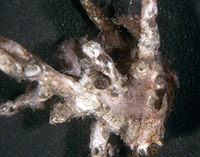
– Enlarged view – |
| • references | |
| Samson J, Fortin JA (1988) Structural characterization of Fuscoboletinus and Suillus ectomycorrhizae synthesized on Larix laricina. Mycologia 80(3): 382-392. Treu R (1990) Charakterisierung und Identifizierung von Ektomykorrhizen aus dem Nationalpark Berchtesgaden. Bibl Mycol 134: 1-196. Treu R (1993) Suillus laricinus. In Agerer R (ed) Colour Atlas of Ectomycorrhizae, plate 81, Einhorn-Verlag, Schwäbisch Gmünd. |
|
| • length | |
| 0 mm | Lower value of unspecified range (could be µ-s.d., but not known) |
| 14 mm | Upper value of unspecified range (could be µ+s.d., but not known) |
| • ramification presence-type | |
| monopodial-pinnate | |
| or | monopodial-pyramidal |
| • tips {per 10 mm} number | |
| 16 | Lower value of unspecified range (could be µ-s.d., but not known) |
| 32 | Upper value of unspecified range (could be µ+s.d., but not known) |
| • ramification orders | |
| 0 | Lower value of unspecified range (could be µ-s.d., but not known) |
| 1 | Upper value of unspecified range (could be µ+s.d., but not known) |
| • main axis diameter | |
| 0.67 mm | Lower value of unspecified range (could be µ-s.d., but not known) |
| 0.77 mm | Upper value of unspecified range (could be µ+s.d., but not known) |
| • rhizomorphs as stout, short, conical structures presence-abundance | |
| absent | |
| • rhizomorphs as short mycorrhiza-like outgrowths with blunt tips presence | |
| absent | |
| • rhizomorphs presence | |
| present | |
| • rhizomorphs frequency | |
| abundant | |
| • exploration type | |
| long distance | |
| • shape | |
| straight | |
| or | bent |
| • shape {of distal end} | |
| not inflated, cylindric | |
| • length | |
| 0 mm | Lower value of unspecified range (could be µ-s.d., but not known) |
| 3.5 mm | Upper value of unspecified range (could be µ+s.d., but not known) |
| • diameter | |
| 0.4 mm | Lower value of unspecified range (could be µ-s.d., but not known) |
| 0.46 mm | Upper value of unspecified range (could be µ+s.d., but not known) |
| • colour | |
| brown | |
| or | red |
| or | white |
| • mantle {distinct} surface visibility | |
| present | |
| • mantle laticifers visibility | |
| absent | |
| • mantle dots presence-colour | |
| absent | |
| • mantle carbonizing presence | |
| absent | |
| • mantle surface {in general} habit | |
| not smooth | |
| • mantle surface {in detail} kind | |
| densely cottony | |
| • emanating hyphae presence | |
| present | |
| • emanating hyphae abundance | |
| abundant | |
| • emanating hyphae distribution | |
| not specifically distributed | |
| • diameter | |
| 0 mm | Lower value of unspecified range (could be µ-s.d., but not known) |
| 0.113 mm | Upper value of unspecified range (could be µ+s.d., but not known) |
| • cross-section shape | |
| round or roundish | |
| • ramification kind-frequency | |
| infrequently, at restricted points | |
| • connection to mantle kind | |
| distinct | |
| • origin location | |
| proximal | |
| • dimorphism presence | |
| absent | |
| • presence | |
| absent | |
| • emanating elements presence-type | |
| rhizomorphs | |
| or | cystidia |
| • emanating elements cystidia location | |
| on outer mantle layer | |
| • blue granules presence | |
| absent | |
| • presence | |
| absent | |
| • organisation | |
| plectenchymatous | |
| • mantle type | |
| occasional patches of roundish cells on the mantle (type F) | |
| • hyphal system kind | |
| undifferentiated | |
| • septa clamps presence | |
| absent | |
| • cell diameter | |
| 2 µm | Lower value of unspecified range (could be µ-s.d., but not known) |
| 4 µm | Upper value of unspecified range (could be µ+s.d., but not known) |
| 7 µm | Maximum value |
| • cell length | |
| 0 µm | Lower value of unspecified range (could be µ-s.d., but not known) |
| 45 µm | Upper value of unspecified range (could be µ+s.d., but not known) |
| • cell wall surface habit | |
| smooth | |
| and | with few crystals |
| • drops of exuded pigment presence | |
| present | |
| • organisation | |
| plectenchymatous | |
| • organisation | |
| plectenchymatous | |
| • septa clamps presence | |
| absent | |
| • mantle thickness {apart from tip} | |
| 32 µm | Lower value of unspecified range (could be µ-s.d., but not known) |
| 40 µm | Upper value of unspecified range (could be µ+s.d., but not known) |
| • outer mantle layer organisation | |
| plectenchymatous | |
| • middle mantle layer organisation | |
| plectenchymatous | |
| • inner mantle layer organisation | |
| plectenchymatous | |
| • presence | |
| present | |
| • anatomy mantle longitudinal section cortical (epidermal) cells shape | |
| tangentially-oval to -elliptic or -cylindrical, and oriented in parallel to root axis | |
| • anatomy mantle longitudinal section cortical (epidermal) cells tangentially length | |
| 83 µm | Lower value of unspecified range (could be µ-s.d., but not known) |
| 150 µm | Upper value of unspecified range (could be µ+s.d., but not known) |
| • anatomy mantle longitudinal section cortical (epidermal) cells radially diameter | |
| 8 µm | Lower value of unspecified range (could be µ-s.d., but not known) |
| 50 µm | Upper value of unspecified range (could be µ+s.d., but not known) |
| • anatomy mantle longitudinal section cortical (epidermal) cells mean tangential length CCt (ECt) | |
| 110.2 µm | Mean (= average) |
| • anatomy mantle longitudinal section cortical (epidermal) cells mean shape-ratio CCq (ECq) | |
| 4.8 | Mean (= average) |
| • outer mantle layer organisation | |
| plectenchymatous | |
| • middle mantle layer organisation | |
| plectenchymatous | |
| • inner mantle layer organisation | |
| plectenchymatous | |
| • presence | |
| present | |
| • rows number | |
| 0 | Lower value of unspecified range (could be µ-s.d., but not known) |
| 3 | Upper value of unspecified range (could be µ+s.d., but not known) |
| • anatomy mantle cross-section cortical (epidermal) cells shape | |
| radially-oval to -elliptic | |
| or | tangentially-oval to tangentially-elliptic |
| • anatomy mantle cross-section cortical (epidermal) cells tangentially length | |
| 10 µm | Lower value of unspecified range (could be µ-s.d., but not known) |
| 42 µm | Upper value of unspecified range (could be µ+s.d., but not known) |
| • anatomy mantle cross-section cortical (epidermal) cells radially diameter | |
| 13 µm | Lower value of unspecified range (could be µ-s.d., but not known) |
| 54 µm | Upper value of unspecified range (could be µ+s.d., but not known) |
| • anatomy mantle cross-section cortical (epidermal) cells mean tangential length CCt | |
| 22.3 µm | Mean (= average) |
| • anatomy mantle cross-section cortical (epidermal) cells mean shape-ratio CCq | |
| 0.8 | Mean (= average) |
| • presence | |
| present | |
| • kind | |
| protruding towards endodermis | |
| • anatomy mantle cross-section hyphal cells around cortical (epidermal) cells shape | |
| cylindrical | |
| • anatomy mantle cross-section hyphal cells around cortical (epidermal) cells thickness | |
| 1.5 µm | Minimum value |
| 2 µm | Lower value of unspecified range (could be µ-s.d., but not known) |
| 3 µm | Upper value of unspecified range (could be µ+s.d., but not known) |
| 4 µm | Maximum value |
| • anatomy mantle cross-section hyphal rows around cortical (epidermal) cells number | |
| one | |
| or | two |
| • backwards-oriented clamps presence | |
| absent | |
| • type | |
| globular (type G) | |
| • septa presence | |
| absent | |
| • septa kind | |
| absent, with basal clamp only | |
| • cell wall colour | |
| brownish | |
| • cell wall thickness | |
| 1 µm | Mean (= average) |
| • cell wall thickness {relative to mantle cells} | |
| thicker | |
| • surface habit | |
| smooth | |
| • shape | |
| not striking | |
| • drops of exuded pigment presence | |
| present | |
| • clamps presence | |
| absent | |
| • clamps hole presence | |
| absent | |
| • clamps blister-like structure {at basis} presence | |
| absent | |
| • anatomy emanating elements emanating hyphae cell diameter | |
| 2 µm | Lower value of unspecified range (could be µ-s.d., but not known) |
| 4 µm | Upper value of unspecified range (could be µ+s.d., but not known) |
| • anatomy emanating elements emanating hyphae cell wall surface habit | |
| with crystals | |
| or | without lens-shaped appositions |
| or | without spindle-shaped appositions |
| • anatomy emanating elements emanating hyphae cell wall thickness | |
| 0.2 µm | Mean (= average) |
| • type | |
| highly differentiated; thick hyphae forming mostly a core, septa often partially or completely dissolved (type F) |
|
| • gelatinized hyphae presence | |
| absent | |
| • cup-like structures on surface presence | |
| absent | |
| • a "ball" of intertwined, ramified, thin hyphae presence | |
| absent | |
| • ampullate, trumpet-like inflated presence | |
| absent | |
| • anatomy emanating elements rhizomorphs hyphae ampullate, trumpet-like inflated presence | |
| absent | |
| • anatomy emanating elements rhizomorphs hyphae ampullate, trumpet-like inflated presence | |
| absent | |
| • anatomy emanating elements rhizomorphs hyphae ampullate, trumpet-like inflated presence | |
| absent | |
| • anatomy emanating elements rhizomorphs hyphae ampullate, trumpet-like inflated presence | |
| absent | |
| • presence | |
| absent | |
| • {of ectomycorrhiza former} presence | |
| present | |
| • {of ectomycorrhiza former} abundance | |
| occasionally present | |
| • shape | |
| globular | |
| • number {per cell} | |
| 2 | Mean (= average) |
| • shape | |
| round | |
| or | oval |
| • diameter | |
| 2 µm | Mean (= average) |
| • distance {between each other} | |
| 1 µm | Lower value of unspecified range (could be µ-s.d., but not known) |
| 8 µm | Upper value of unspecified range (could be µ+s.d., but not known) |
| • geographic occurrence continent | |
| Europe | |
| or | North America |
| • knowledge about association with foreign fruitbodies presence | |
| known | |
| • plant family | |
| Pinaceae | |
| • plant genus | |
| Larix | |
| • plant habitat kind | |
| forests, woods | |
| • family | |
| Boletaceae | |
| • subfamily | |
| Boletaceae subf. Suilloideae | |
| • fruitbodies growth habit | |
| epigeous | |
| or | pileate-porioid |
| • public notes | |
| Mycorrhizal systems mostly monopodial-pinnate, infrequently monopodial-pyramidal; mycorrhizal ends mostly straight, infrequently bent, dirty-white to brownish, partially with a reddish hue; outer mantle layers in plan view with vacuolarly reddish cells; autofluorescence of mantle in section with UV-filter bluish, with blue-filter yellowish; mantle in KOH with red pigment becoming deeper coloured and whole mycorrhizae reddish brown, in lactic acid pigment becomes brownish to colourless, in NH4OH whole mycorrhizae reddish brown. | |